
Can You Have a Second Facelift? When a Revision Facelift Makes Sense
Many patients consider a second or revision facelift years after their first procedure. Here’s what makes secondary surgery different and how Dr. Stephen Fink approaches it in Newport Beach.
A well-done facelift does not stop aging. Over time, soft tissues continue to descend and volume continues to change. Some patients return years later wanting to restore definition again.
A second facelift is not simply a repeat of the first. Scar tissue, prior vectors, and changes in anatomy all affect the plan.
This guide explains when revision makes sense. Related topics: jowls treatment, mini facelift for early jowls, and facial volume loss after weight loss.
Key Takeaways
No facelift is permanent. Secondary surgery is common many years later.
Scar tissue and prior dissection change how the second operation is planned.
Some patients need more lift; others need volume or refinement of a prior result.
Waiting until tissues have fully settled and aging has progressed is usually wiser than early re-operation.
Secondary facelifts benefit from a surgeon experienced in revision facial surgery.
Why Patients Consider a Second Facelift
Years after a successful first facelift, the face continues to age. Jowls can reappear, the neck can loosen again, and volume can shift. Some patients also want to refine aspects of a prior result performed elsewhere. Both situations can lead to a discussion about secondary surgery.
How a Revision Facelift Differs from a First Facelift
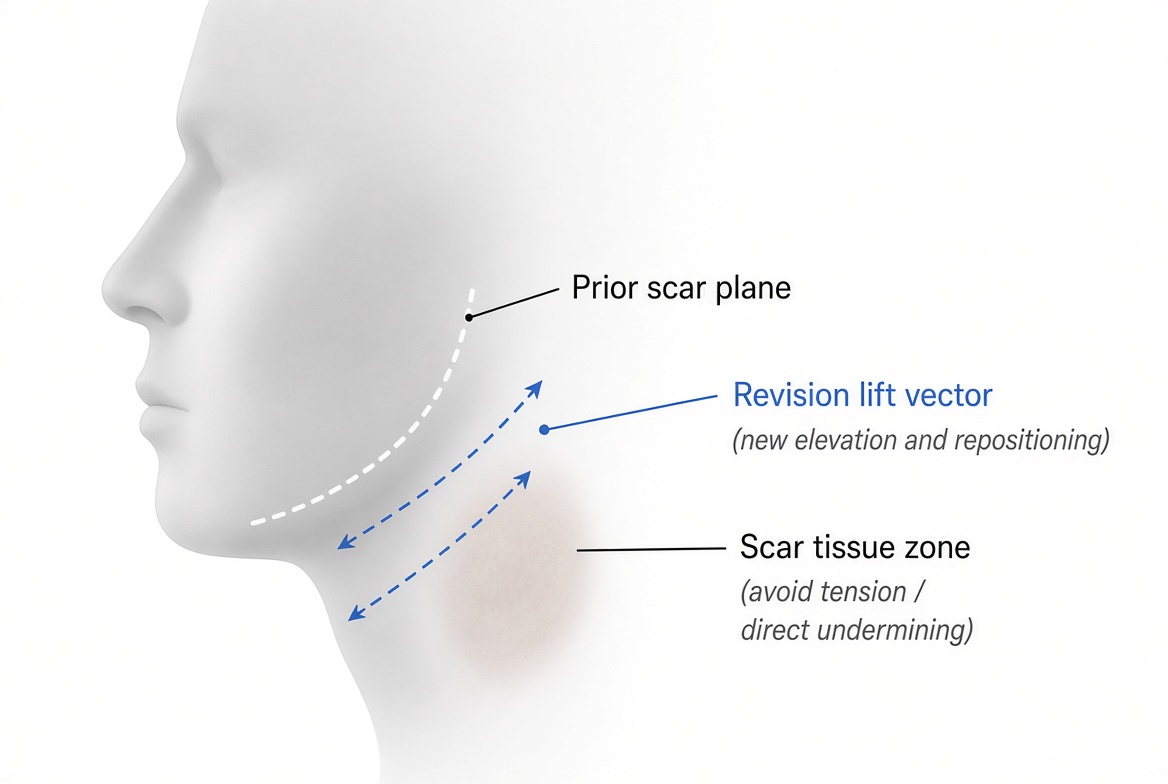
Scar tissue from the original operation changes tissue planes. Prior incision placement and the direction of earlier lifting affect what can be done safely and effectively the second time. The surgeon must adapt the plan to the anatomy that exists now, not the original anatomy.
When Does a Second Facelift Make Sense?
Most patients wait many years—often a decade or more—before considering revision. Early re-operation for minor residual concerns is usually less successful than allowing full healing and then addressing significant recurrent aging. Volume loss after major weight change is a separate discussion—see facial volume loss after weight loss.
Who Is a Good Candidate for Revision?
Candidates are healthy, have realistic expectations, and understand that secondary surgery is more complex. Prior operative reports and photos help planning when available. Patients who had an overly aggressive first lift may need a more conservative secondary approach.
Recovery After a Second Facelift
Recovery is similar in broad outline to a primary facelift—swelling, bruising, and gradual return to activity—but individual healing can be influenced by prior surgery. Close follow-up remains important.
FAQ
How many years after the first facelift should I wait?
Can a mini facelift work as a second procedure?
Will scars be worse the second time?
Is revision more expensive?

Restoring Definition Again—Still Looking Like You
A carefully planned second facelift can address recurrent aging while respecting the changes created by the first procedure.
Discuss Whether a Second Facelift Is Right for You
Meet with Dr. Stephen Fink at Newport Faces to review your prior surgery, current anatomy, and realistic options for revision.